The Hidden Bottleneck Ruining Your Late-Summer Comfort
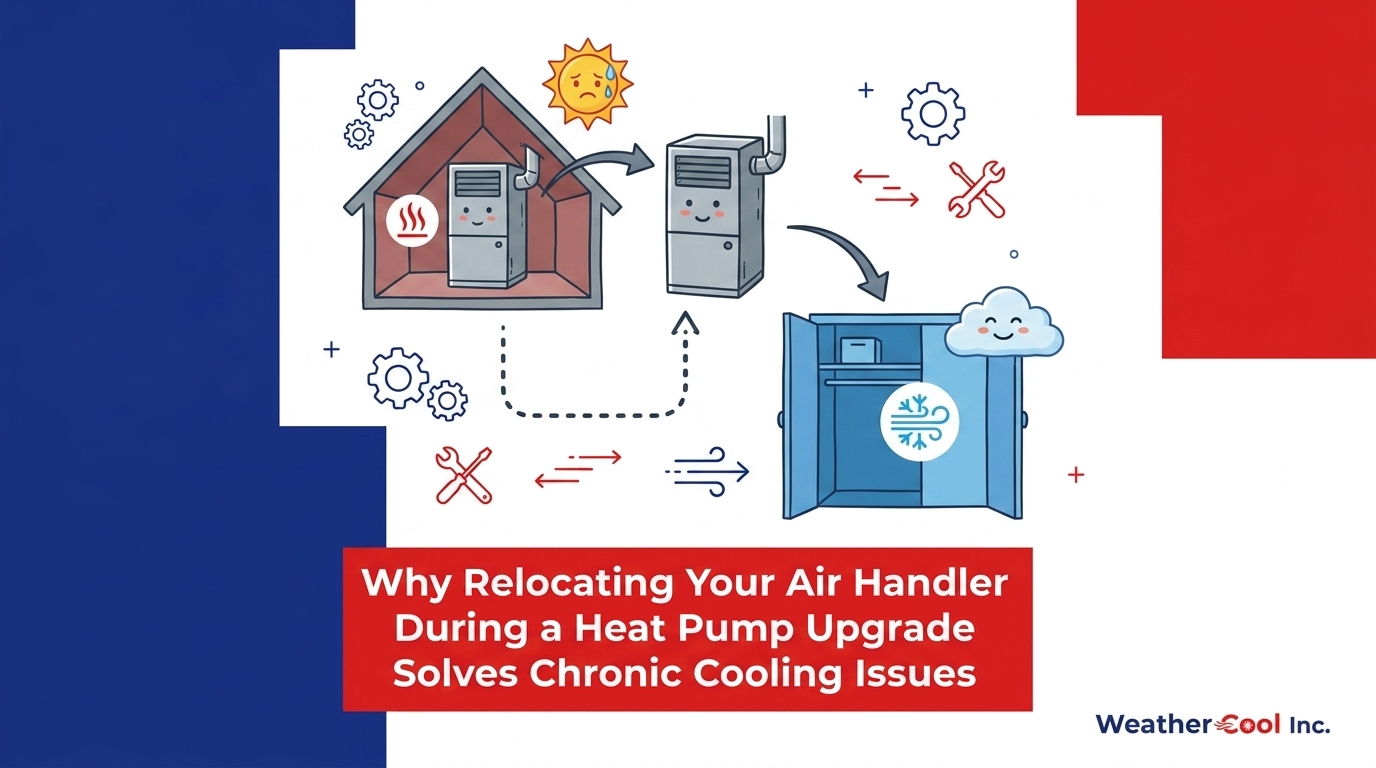
Your air conditioner is running nonstop against the intense August late-summer heat, yet certain rooms in your home still feel like an oven. If you are wondering why relocating your air handler during a heat pump upgrade solves chronic cooling issues, the answer usually lies hidden in a cramped closet. Many homeowners assume that simply buying a powerful new outdoor unit will instantly fix their hot spots and airflow problems. However, true comfort requires addressing the physical bottleneck inside the home, not just the machinery sitting outside.
If you are tired of uneven temperatures and poor airflow, exploring professional HVAC services for a comprehensive heat pump installation can finally restore balance to your home.
The false promise of the outdoor swap: It is incredibly frustrating to invest in a brand-new, high-efficiency system only to experience the exact same stifling temperatures in your master bedroom or upstairs office. The reality is that your cooling system is a two-part team. The outdoor compressor does the heavy lifting of heat transfer, but the indoor air handler is entirely responsible for distributing that conditioned air. When the indoor unit is trapped in a location that physically restricts its ability to breathe, no amount of outdoor cooling power can overcome that barrier. Before you finalize your next system upgrade, you must evaluate whether your current air handler location is secretly sabotaging your comfort.
Why Upgrading the Outdoor Unit Isn’t a Magic Cure
The Problem: In our years of providing cooling solutions, we’ve seen many homeowners in Stafford TX invest heavily in top-tier, high-efficiency outdoor heat pumps, expecting a complete transformation of their indoor climate. They anticipate that a newer, stronger unit will automatically force cold air into the stubbornly hot corners of their home. Unfortunately, our technicians often find that the new system performs exactly like the old one, leaving families with the same poor airflow and frustrating hot spots they paid to eliminate.
The Cause: An HVAC system acts as a single, interconnected breathing organism. It operates on a continuous loop of pulling warm air in and pushing cool air out. A powerful outdoor unit cannot push a high volume of cold air into your living spaces if the indoor air handler cannot pull enough warm return air through a choked, undersized intake. Original home builds frequently squeezed air handlers into tight hallway closets, narrow utility niches, or restrictive drop ceilings to save square footage. These confined spaces simply do not meet the air volume requirements of modern, high-efficiency blowers.
The Solution: Recognizing that the indoor unit’s physical location dictates the success of the entire system is the first step toward true comfort. Ignoring a restrictive indoor location severely limits the return on investment for your new equipment. By evaluating the space and understanding that a powerful outdoor unit is useless without adequate indoor airflow, you can make the strategic decision to correct the underlying structural flaw rather than just swapping out the machinery.
The Symptoms of a Choked Indoor Unit
How do you know if your current air handler location is restricting your system? Look for these common warning signs that our team encounters daily:
- Whistling vents: High-pitched noises at your return grilles indicate the blower is struggling to pull enough air through a restricted space.
- Slamming doors: If interior doors pull shut on their own when the system kicks on, your home has severe pressure imbalances caused by poor airflow geometry.
- Extreme temperature variances: A difference of more than a few degrees between rooms often points to a central bottleneck at the air handler rather than an issue with the outdoor unit.
- Excessive dust buildup: When an air handler is starved for air, it can pull dusty, unconditioned air from wall cavities or attics through tiny leaks in the ductwork.
The Physics of Airflow: How Cramped Closets Choke Blower Motors
To truly grasp why a system fails to cool your home evenly, you have to look at the fluid dynamics of air volume. A cramped hallway closet physically restricts the amount of return air entering the system. Think of your air handler’s blower motor like a vacuum cleaner. If you place your hand over the vacuum hose, the motor immediately strains, pitches up in sound, and loses its suction power. The exact same physics apply when an air handler is shoved into a space that is too small for its intake needs.
This physical restriction dramatically increases the system’s static pressure. Static pressure is the resistance to airflow within your duct system. When a blower motor has to fight against high static pressure caused by a cramped location, it is forced to overwork constantly. This not only destroys your energy efficiency during the August late-summer heat, but it also causes the motor to run dangerously hot, eventually leading to premature mechanical failure.
ACCA Manual D Standards: The Air Conditioning Contractors of America (ACCA) sets the industry standards for proper duct design, known as Manual D. These standards dictate that optimal airflow requires adequate physical space for proper duct geometry. You cannot force high volumes of air through sharp 90-degree turns right off the air handler without creating massive turbulence and pressure drops. Moving the unit out of a restricted space immediately relieves this pressure, allows for sweeping, efficient duct transitions, and restores balanced airflow.
For a deeper dive into how static pressure and duct design impact your daily comfort, understanding HVAC air flow problems is essential for any homeowner planning a major equipment upgrade.
| System Factor | Cramped Closet Location | Optimized Relocation Space |
|---|---|---|
| Return Air Volume | Severely restricted, starving the blower | Abundant, allowing full system capacity |
| Static Pressure | High resistance, causing turbulence | Low resistance, promoting smooth airflow |
| Blower Motor Strain | High wear and tear, runs excessively hot | Normal operation, extends component lifespan |
| Duct Geometry | Requires sharp, inefficient turns | Allows for smooth, sweeping duct transitions |

Losing the Dehumidification Battle in High Humidity
The Problem: In Stafford TX, the subtropical climate means we deal with incredibly high relative humidity, especially as families transition back to school at the end of the cooling season. Our team constantly hears from homeowners who find that even when their thermostat reads a cool 72 degrees, the house feels sticky, damp, and uncomfortable. This clammy feeling is a direct result of the system failing to manage indoor moisture.
The Cause: Air conditioning is essentially a two-part process: sensible cooling (lowering the actual temperature) and latent cooling (removing moisture from the air). Latent cooling is critical in our region. When an air handler is restricted in a tight space, it fails to move an adequate, steady volume of air over the indoor evaporator coil. Because the airflow is erratic or insufficient, the system often short-cycles—turning on and off rapidly. Dehumidification requires long, steady run times to pull moisture out of the air and drain it away. A choked system simply never runs long enough to extract that heavy indoor humidity.
The Solution: Proper air handler placement allows the new heat pump to operate exactly as the manufacturer intended. By relocating the indoor unit to a space that supports full airflow, the system can run in long, efficient cycles. This steady flow of air across the evaporator coil maximizes latent cooling, stripping the heavy moisture out of your indoor air. The result is a home that feels crisp and comfortable, rather than cold and clammy.
Why Moisture Matters More Than Temperature
Human comfort is heavily dependent on the evaporation of moisture from our skin. When indoor humidity levels climb above 50-60%, that evaporation slows down dramatically. This is why a humid home at 74 degrees feels significantly hotter and more uncomfortable than a dry home at 78 degrees. Forcing your new heat pump to operate with a choked air handler guarantees that you will lose the dehumidification battle, forcing you to lower the thermostat further and waste energy just to feel dry.
Real-World Diagnostics: Fixing Duct Geometry Beyond the Manual
Generic manufacturer specifications look great on paper, but they rarely account for the reality of typical home builds and their unique spatial constraints. A frequent pattern our team at Weather Cool Inc. sees in Stafford TX homes involves original builders prioritizing floor space over HVAC functionality. They tucked air handlers into the smallest possible footprints, leaving homeowners to deal with the consequences decades later when trying to install modern, high-efficiency equipment.
A thorough evaluation of existing duct geometry reveals exactly why certain rooms never cool down. It is rarely a failure of the equipment itself; it is a failure of the pathways delivering the air. When our technicians map out the static pressure and trace the ductwork, the bottlenecks become glaringly obvious. Sharp 90-degree elbows directly off the supply plenum, crushed flexible ducts trying to squeeze past structural beams, and undersized return drop boxes are the true culprits of your discomfort.
A pattern of successful relocations: For example, one local homeowner reached out to our crew during a busy late May spring rush for a system replacement. Their original setup was choked by poor placement, leading to chronic hot spots. A professional evaluation determined that leaving the unit in its original spot would ruin the new system’s efficiency. Our technician installed the new air handler in an optimized, newly designated location and relocated the air ducts to match proper geometry. This strategic move greatly improved physical access to the unit and allowed the ductwork to be completed cleanly, instantly resolving the home’s chronic airflow bottlenecks without needing to upsize the outdoor unit.
Optimized duct routing from a new location eliminates sharp turns. When an air handler is moved to a space that allows for a proper return plenum and a straight, unrestricted supply trunk, the physics of airflow work with your system instead of against it.
Strategic Relocation Spaces That Transform System Efficiency
If your current air handler location is identified as a bottleneck, where should it go? Identifying the right strategic relocation space is often the critical missing step in a successful system overhaul. Here are the most effective options we recommend for relocating an indoor unit to maximize your comfort against the August late-summer heat.
- The Accessible Attic Installation: Moving a unit from a tight hallway closet up into a spacious, accessible attic area is one of the most common and effective solutions. An open attic allows technicians to build wide, sweeping return plenums and perfectly straight supply trunks. It also provides ample room to install high-capacity media filtration systems that simply would not fit in a standard closet.
- The Dedicated Utility Room: If attic space is limited or unconditioned, relocating the air handler to a larger, dedicated utility room or laundry room is an excellent alternative. This provides the necessary square footage for proper ACCA Manual D duct geometry while keeping the unit within the conditioned envelope of the home, which further boosts energy efficiency.
- The Conditioned Crawlspace: For homes built on pier and beam foundations, a clean, encapsulated, and conditioned crawlspace can serve as an ideal location. It keeps the equipment out of the living space while allowing for massive, unrestricted return air drops through the floor system.
Secondary benefits of relocation: Beyond the massive improvements in airflow and temperature balance, physical relocation offers significant quality-of-life upgrades. Modern blower motors are quieter than older models, but they still generate operational noise. Moving the air handler out of a central hallway or bedroom closet and into an attic or utility room drastically reduces indoor noise levels. You will no longer have to turn up the television every time the cooling system kicks on.
If you are planning a major system upgrade, ensuring your indoor unit has the space it needs is paramount. Professional HVAC installation focuses just as heavily on the placement and geometry of the indoor components as it does on the outdoor compressor.
Long-Term Reliability and Lower Operating Strains
Eliminating airflow restrictions does not just make your home more comfortable today; it protects your investment for the next decade. When an air handler is placed in an optimal location with proper duct geometry, the reduction in static pressure directly translates to lower energy consumption. The blower motor no longer has to draw maximum amperage just to force air through a tiny opening. It can operate smoothly at lower speeds, significantly reducing your monthly electrical usage.
Furthermore, proper placement drastically reduces the wear and tear on critical system components. In a restricted system, the blower motor runs hot and works overtime, leading to premature bearing failure or burned-out modules. Simultaneously, the outdoor compressor suffers. When the indoor unit cannot move enough air over the evaporator coil, the refrigerant returning to the compressor isn’t properly vaporized. This can cause liquid refrigerant to slug the compressor, leading to catastrophic failure.
Preventing the freeze-up: Properly installed systems with optimized airflow are also far less likely to experience frozen evaporator coils. A frozen coil in Stafford TX usually happens when a lack of airflow prevents the system from absorbing enough heat from the home, causing the condensation on the coil to drop below freezing. By investing in relocation during an upgrade, you ensure a steady, high volume of air keeps the coil operating at the correct temperature.
Protecting the lifespan of your new equipment starts with giving it the environment it needs to succeed. This is why a comprehensive AC replacement must always include a rigorous evaluation of your ductwork and air handler placement.
Common Questions About Air Handler Placement and Upgrades
Why does my new heat pump have poor airflow?
Poor airflow on a brand-new system is often caused by keeping the old, restrictive indoor air handler location. The outdoor unit can only push as much conditioned air as the indoor ductwork allows it to circulate. If the new indoor unit is shoved back into the same cramped closet that choked your old system, the blower motor will struggle against high static pressure. Upgrading the machinery without upgrading the physical airflow pathways will always result in disappointing performance.
Where is the best location for an HVAC air handler?
The best location for an air handler is an area with ample physical space for proper duct geometry, such as an accessible attic, a large utility room, or a conditioned crawlspace. These locations allow technicians to build wide return plenums and smooth, sweeping duct transitions. You should always avoid cramped hallway closets or tight niches that restrict return air volume and force sharp, inefficient turns in the ductwork.
How does air handler placement affect cooling?
Placement directly dictates the static pressure of your ductwork and the system’s ability to dehumidify your home. When an air handler is restricted, it cannot pull enough warm air over the evaporator coil, leading to poor heat transfer and short-cycling. This poor placement results in clammy indoor conditions because the system never runs long enough to extract heavy humidity from the air, a common problem for homes in Stafford TX.
Does an air handler have to be relocated during a replacement?
An air handler does not always have to be relocated, but it is highly recommended if the current location causes chronic hot spots, whistling vents, or airflow restrictions. A professional evaluation determines if the existing space meets modern airflow standards. If your current setup violates ACCA Manual D guidelines for static pressure, relocating the unit is the only way to ensure your new system operates efficiently.
Can moving my indoor HVAC unit improve dehumidification?
Yes, moving your indoor unit to a less restrictive location is one of the best ways to improve dehumidification. A well-placed air handler allows the blower to move the correct volume of air steadily, allowing the heat pump to run in longer, more efficient cycles. These longer cycles are absolutely necessary for pulling heavy latent moisture out of the air, keeping your home feeling crisp and dry.
Maximize Your Upgrade Strategy With Optimized Airflow
True comfort requires a holistic approach that addresses the physical bottlenecks inside your home, not just the mechanical components outside. Upgrading to a high-efficiency heat pump is a fantastic investment, but if that new system is forced to breathe through a cramped, restrictive closet, it will never deliver the performance you paid for. The August late-summer heat is unforgiving, and overcoming it requires a system that can move air freely and effortlessly.
A clear, physics-based approach to duct airflow ensures that your new system actually solves your chronic cooling problems rather than just masking them. By acknowledging that static pressure and duct geometry are just as important as SEER ratings, you can make informed decisions about your home’s infrastructure. At Weather Cool Inc., our team highly encourages all homeowners to have their duct geometry and indoor unit placement professionally evaluated before finalizing any major equipment upgrade. Taking the time to optimize your airflow now will guarantee a cooler, drier, and more comfortable home for years to come.